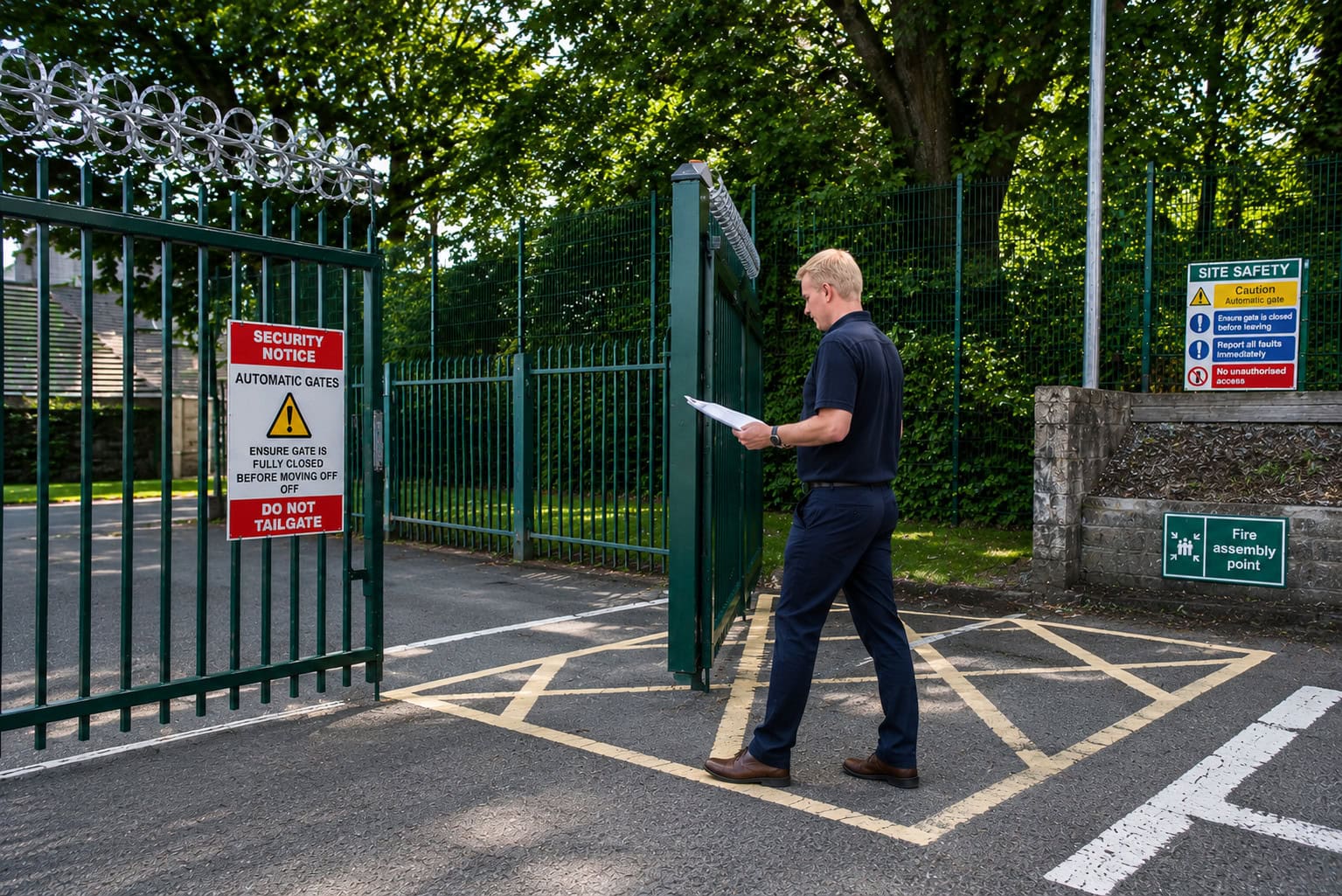
If an automatic gate opens and closes when it should, it’s very easy to assume it’s safe.
Unfortunately, that’s not always the case.
Premier Gate Automation has been working with automatic gates since 1989, and this is something we come across regularly – particularly with older installations that have been maintained and repaired over many years.
The gate may work perfectly well. It may have photocells. It may even have relatively new automation. But gate safety isn’t determined by any one of those things.
The whole installation needs to be considered.
“But the gate has photocells…”
This is probably one of the most common things we’re told when discussing gate safety.
Photocells are important, but they don’t automatically make an installation safe.
They will detect someone or something breaking the beam, but they may not protect against every crushing, trapping or impact point created by the moving gate.
Where the photocells are positioned matters too, as does what the gate actually does when they’re activated.
Depending on the installation, additional protection may be needed. This could include monitored safety edges, guarding or alterations to the way the gate operates.
There isn’t a standard safety package that can simply be fitted to every automatic gate. What is required depends on the gate itself and the risks around it.
Will a New 24V Motor Make an Older Gate Safe?
It can certainly help, but it isn’t the whole answer.
Modern low-voltage automation is a big improvement on many older systems. Modern operators and control panels can offer much better control over movement and forces and work with today’s monitored safety equipment.
We therefore regularly recommend modernising older automation where appropriate.
What a new motor can’t do is remove a physical crushing or trapping point elsewhere on the gate.
If there is an unsafe gap between a gate and a post, for example, changing the motor doesn’t make that gap disappear. The same applies to hazards around hinges, walls, fencing or the area into which a gate travels.
So yes, modern automation can make a significant difference, but we still need to look at the gate as a complete system.
Does an Older Gate Need Replacing?
Not necessarily.
We still maintain plenty of older gates that are mechanically sound and perfectly capable of remaining in service.
What matters is their condition.
Over time, hinges wear, rollers deteriorate, safety edges become damaged and photocells can be knocked out of position. Underground motors can suffer from water ingress, while sliding gates can develop wear in their guides, rollers and running gear.
Safety expectations and gate technology have also moved on considerably.
Sometimes an older gate simply needs maintenance and a few improvements. In other cases, more substantial safety work or modernisation may be appropriate.
We’d rather assess the existing installation properly than recommend replacing equipment simply because it’s old.
Swing Gates and Sliding Gates Aren’t the Same
The risks are different.
With sliding gates, we’re particularly interested in the areas the gate travels past or into. Walls, railings and fencing alongside the gate can potentially create trapping or drawing-in points. Guides, rollers and end stops also need to be checked.
Swing gates have different areas to consider, particularly around the hinges and posts and across the path travelled by the gate leaves.
This is why an automatic gate can’t really be assessed properly by looking at the motor and photocells alone.
What Should a Gate Maintenance Visit Actually Include?
A maintenance visit should obviously include checking the operation of the automation and the mechanical condition of the gate.
But it shouldn’t stop there.
Our engineers also need to consider the safety equipment and whether anything has changed or deteriorated since the previous visit.
Automatic gates spend their lives outside. They’re exposed to rain, frost, dirt, vehicle movements and thousands of operating cycles. Things move, wear and occasionally get damaged.
If we find a safety issue during maintenance, we’ll tell you.
Sometimes it’s something straightforward that can be addressed relatively easily. Other times we may recommend further safety works.
We won’t overlook a significant safety issue simply because the gate still opens and closes.
Not Sure About Your Existing Automatic Gate?
If you’re responsible for an automatic gate and aren’t sure whether it is adequately maintained or protected, we can take a look.
Premier Gate Automation has been installing, repairing and maintaining automatic gates since 1989, so we’ve worked with several generations of gate automation – from older systems that are still giving good service to the latest low-voltage equipment and monitored safety technology.
We’ll assess what’s already there, explain any issues we find and advise on what we believe is actually required.
Premier Gate Automation provides automatic gate maintenance, repairs, safety upgrades and new installations throughout Essex, London and the surrounding areas.
If you’d like us to inspect an existing automatic gate or discuss an ongoing maintenance programme, contact the Premier Gate Automation team.